Showing posts with label loan. Show all posts

Thursday, January 9, 2014

Housing tear-downs on the rise as real estate rebounds

With little vacant land left, developers and wealthy buyers are razing small, older houses in sought-after Southern California neighborhoods to build modern mansions.

0

By Andrew Khouri
The front-end loader swung to the right and took a bite out of the shingled roof of the quaint cottage. The roar of the engine and crackle of buckling lumber carried down Elm Avenue in Manhattan Beach.
Within 40 minutes, a demolition crew reduced the 1950s one-story to rubble. The 782-square-foot house would be replaced by a 3,300-square-foot Cape Cod.

"It feels exactly like the good old days," said the property's developer, Mike Leonard.
Those days of booming demolition and construction came during last decade's housing bubble. Now, tear-downs are again on the rise in Southern California's affluent communities, as a rebounding housing market triggers a residential reconstruction boom.

With little vacant land left, developers and wealthier buyers are snapping up small, older houses in sought-after locales, then leveling them to build modern mansions.

The wave of demolition has revived criticism that the new homes tower over those next door and clash with neighborhood character. Residents complain that their once-quiet streets have become perpetual construction zones.

The upscale South Bay town of Manhattan Beach exemplifies the trend. Builders in the city pulled permits to demolish 84 residential units from July 2012 to June 2013, the latest available data. That's nearly double the number pulled for the same period a year earlier. In August, one Manhattan Beach City Council member described the ongoing construction as a "tsunami."

That force has rattled Manhattan Beach homeowner Jane Guthrie. This summer, she said, workers hammered large metal beams into the ground a few houses away from her one-bedroom house, shaking the walls. Workers, she said, were installing a deep basement for a 3,500-square-foot, three-level house that replaced a small 784-square-foot cottage near the beach.

"It was like having an earthquake in your living room — for six hours a day," said Guthrie, a retired art director for ad agencies.

The rebounding housing market has sparked the demolitions. In November, the median price for a home in Southern California was $385,000, up nearly 20% compared with the same month a year earlier, according to research firm DataQuick. Builders such as Leonard are constructing houses "on spec," confident that they'll find buyers.

In other cases, wealthy homeowners are buying cottages, then hiring builders to knock them down and erect dream homes.

"You've got an amazing increase in new construction coming on the market" in Santa Monica, Brentwood and Pacific Palisades, said F. Ron Smith, a founding partner at high-end real estate brokerage Partners Trust.

In the city of Los Angeles last year, builders received approval to raze 1,227 houses and duplexes from January through mid-December, according to Department of Building and Safety records. That's 29% higher than in all of 2012, though still well off the pace of more than 3,000 in 2006, during the housing bubble.

Developer Igal Azran recently built a five-bedroom house near the Beverly Center in Los Angeles. The 5,000-square-foot mansion replaced a modest, one-story Spanish-style home. With glass walls and vaulted ceilings, the modern two-story towers over the adjacent 1920s homes with red-tile roofs. Public records show Azran bought the property — then a 2,180-square-foot duplex — for $856,500 in 2011. The house he built sold in October for $3.5 million.

Construction of new, high-end homes raises property values for neighborhoods, Azran said. Those building their homes shouldn't be confined to the sizes and styles favored by their neighbors, he said.
"People like different things — people like Spanish, modern, French-style," he said.

But many longtime residents resent the scrapping of quaint, older homes, including Clark Carlton, 57, who lives near Azran's project. He says he's growing his hedges higher to regain privacy lost to another newly constructed mansion.

"I am at the point now I have to make sure I am decently clothed to cross my backyard," he said.
Carlton and his neighbors want the city to take action. They are pushing Los Angeles to tighten the so-called anti-mansionization ordinance passed in 2008. Critics say it has failed to stop the construction of outsized homes that rob views, block sunlight and alter the character of established neighborhoods.
In October, the Los Angeles City Council imposed additional size limits on new houses in the Beverly Grove neighborhood. But the changes don't mandate a particular style.

"The new restrictions will support long-term property values," said neighborhood activist Shelley Wagers, who pushed for the measure. "Mansionization has been a matter of profiteering, and has made quick money for a few people at the expense of their neighbors."

Tear-downs have long stirred controversy, especially in beach communities — once-funky towns that have seen property values skyrocket over the years amid an influx of wealthy residents, chic boutiques and cafes. Many who grew up in the area have moved out, unable to afford a house with an ocean breeze. Many who did own homes couldn't resist cashing in.

Death often precedes a tear-down. For example, when an elderly homeowner passes away and children choose to sell rather than live in the property. The competition for what developers call lots — because the land is more valuable than the house — is fierce.

Prominent Manhattan Beach builder Matt Morris recalled a lot he purchased in the spring.
"I overpaid, in my mind, by $250,000," he said.

The day after he went into escrow, Morris said, another developer offered to pay $150,000 more for the property. He declined the offer. There are simply too few lots available. And Morris believes he stands to make more upon selling the newly built house.

Manhattan Beach, which long ago morphed from a quaint beach town to ritzy burb, has recently been debating tightening its anti-mansionization ordinance, which aims to reduce the visual bulk of new homes and preserve older ones.

Leonard, the developer who demolished the Manhattan Beach cottage in October, said he is "ambivalent" about the new restrictions under consideration.

"As long as it satisfies the residents," said Leonard, who has constructed many Cape Cod-style houses throughout the city. "If the city and residents want small, I build small. If they want bigger, I build bigger."
Other local developers, however, have criticized the proposed changes. After the push-back, the City Council voted in November to send the proposals to the Planning Commission for further study.
Richard MacKenzie worries about what will come next on the empty dirt lots across from his 1955 house. He said he believes construction of a planned deep basement on the land will shift the ground and damage his house, as well as those of neighbors.

The project's developer declined to comment. But plans filed with the city describe a 9,000-square-foot, three-story mansion with an elevator, wine cellar, bar and game room. The master bedroom will have an expansive outdoor deck with a spa tub.

MacKenzie said such giant luxury homes, and the Kardashian lifestyle they represent, threaten the community's beach vibe along with the landscape. To him, Manhattan Beach is starting to feel more like Beverly Hills.

"Why move to the beach?" MacKenzie asked. "You used to walk on the beach and say hi to people. Now people have their own worlds they live in."


andrew.khouri@latimes.com
Copyright © 2014, Los Angeles Times

http://www.latimes.com/business/realestate/la-fi-housing-tear-downs-20140104,0,5252206.story#ixzz2pjo7J5Oj

Wednesday, January 8, 2014

14 Predictions We Like for 2014

By Mark Heschmeyer |COSTAR
Real Estate Prognosticators See CRE Recovery Continuing To Accelerate in 2014


Real Estate Prognosticators See CRE Recovery Continuing To Accelerate in 2014
Commercial real estate firms are moving into the New Year with a renewed sense of optimism - a positive outlook not seen for the past seven or eight years.

While many in the industry predicted a recovery in 2013, they did so with a sense of nagging worry over slower than expected job growth and concerns that the political brinkmanship in Washington could threaten the nation's credit rating and pitch the economy into stagnation or, even worse, recession.

Much of those concerns have ebbed as the two parties came to terms in December over next year’s budget. In addition, the Federal Reserve has established a clear path for rolling back the so-called quantitative easing steps taken in years past to bolster the economy. By spelling out its path for reducing debt purchases, the Fed has taken out much of the guesswork for when those financial supports will end.

Given the overhanging sense of dread seems to have disappeared from most forecasts, experts are predicting a better year in 2014.

CoStar News has encapsulated Following 14 outlooks for 2014 from forecasts offered by respected industry participants and observers. We’ve sorted them alphabetically by the firm making the forecast.


Cassidy Turley: Impact from Rising Rates


If the big economic story of 2013 was policy vs. housing, this year doesn’t promise much in the way of variety. Policy vs. Housing, Part II will see the same threats to economic growth as we continue to struggle with dysfunction in Washington and, most likely, more political brinksmanship that may undermine confidence in the economy. But, while the challenges will be the same, the underlying fundamentals will be slightly stronger. Perhaps the biggest difference is that by the middle of 2014, economic growth should be strong enough for inflation to start to be a possibility once again. This is actually a good thing. The timetable could vary, but we anticipate the Fed raising interest rates by the end of the second quarter-likely in May or June. So long as interest rates don’t move too far too fast, the impact on the overall economy will be minimal. But there will be one. This could slow the housing recovery and it will certainly have an impact on commercial real estate pricing as the price of borrowing becomes more expensive. But that is assuming the underlying economic fundamentals have heated up to the point of warranting such a move-which is ultimately a good thing. A stronger economy may bring higher interest rates, but it will also bring higher earnings, lower unemployment, greater consumer spending and-for landlords-better rental rate growth and NOI. In the meantime, look for the first big political squabble (over the debt ceiling once again) to start up again in late January.

CBRE: Office Market Recovery Poised To Accelerate


The office market recovery is poised to accelerate in 2014, as an improving economy should result in increased office-using employment according to CBRE, the world’s largest commercial real estate services and investment firm. The growth in office-using occupations, particularly in high-tech industries, is expected to increase demand foroffice space. The U.S. office market vacancy rate will continue to decline next year, falling by 80 basis points (bps) to 14.3% by the end of 2014, Steady improvement in the office market is expected to continue in 2015, with the vacancy rate forecasted to dip another 80 bps to 13.5%. CBRE forecasts that office rents will increase by 3%, on average, in 2014, and rise another 4.4% in 2015, as vacancy levels fall steadily toward the “equilibrium” level over the next two years.

Cornell Univ. and Hodes Weill: Big Money Will Continue To Rule


Institutions are significantly under-invested in real estate and are poised to allocate significant capital to new real estate investments. The weight of this capital can be expected to have broad implications for the industry, including transaction volumes, fund raising, lending activity and property valuations. The supply of capital may sustain current valuation and financing metrics (including capitalization rates and the cost of debt capital), according to Cornell University’s Baker Program in Real Estate and Hodes Weill & Associates, which co-sponsor the Institutional Real Estate Capital Allocations Monitor.

Deloitte: Steady Growth but Not Enough To Spur Much New Development


CRE fundamentals continue to improve across all property types, including vacancy, rent, and absorption levels, according to Deloitte's real estate forecast. However, demand is yet to increase enough to drive development activity, except for multifamily and hotel construction, which continues to be robust. These same sectors, which were the first to grow and recover after the recession, may see some tapering off in fundamentals as new supply comes to the market. Overall, it appears that fundamentals will continue to improve at a moderate pace, in line with the macroeconomic situation.

DTZ: Business Tenants Keep Bargaining Clout


The U.S. economy will continue to expand at a moderate rate, which will lead to more job growth and a related increase in demand for occupational space, reports global property services firm DTZ. However, with the expected moderate job growth, vacancy will only trend down slowly. Occupiers will remain in good bargaining positions over the next two years and occupancy costs will increase in line with inflation. They will continue to receive concessions as landlords compete to increase their properties' net operating income. Occupiers will gravitate to the most affordable markets and continue to reduce their costs through more efficient internal space build-outs.

EY: Private Equity Funds Getting Hands Dirty


Having emerged from the global recession and its aftermath, the real estate private equity sector is finally positioned for growth in 2014, according to a global market trends outlook in real estate private equity published by EY (Ernst & Young). Strategies being deployed by different PE firms and even funds to take advantage of this growth opportunity differ, as fund managers seek to differentiate themselves in a hotly competitive fundraising environment. But EY sees fewer opportunities in the future for fund managers to capitalize purely from the financial structuring side of their investments. The funds that come out ahead of the competition in this next phase of growth will have one thing in common: an 'old school' asset management approach that realizes maximum investment value by working closely with service providers to fill buildings and manage real estate.

Freddie Mac: The Emerging Purchase Market


Led by a resurgent housing sector, 2014 should shape up to be better than 2013 with a quickening recovery pace leading to more job creation. Freddie Mac expects single-family home sales and housing starts to be at their highest levels since 2007, and expect multifamily transactions and construction to post gains as well. The big shift ahead will occur as the single-family mortgage market begins transitioning from a rate-and-term refinance-dominated market, to a first purchase-dominated market. The emerging home-buyer purchase market should gather momentum in the coming year.

Grant Thornton: Huge Boost Ahead for Industrial Markets


U.S. companies will bring production, customer service and IT infrastructure back home, reports tax-advisory firm Grant Thornton. The reshoring trend is real and about to dramatically reshape the U.S. economy. More than one-third of U.S. businesses will move goods and services work back to the U.S in the next 12 months, which means that as much as 5% overall U.S. procurement may return home. The Grant Thornton LLP "Realities of Reshoring" survey found that even IT services, one of the first business functions to move offshore, are likely to return within a year. The trend could provide an enormous boost to domestic manufacturers, retailers, wholesalers/distributors and service providers.

Jones Lang LaSalle: Pent Up Retail Demand Will Drive Investment


Total retail investment is expected to increase upwards of 20% in 2014, according to Jones Lang LaSalle, as pent up demand that was not satisfied in 2013 fuels investments and investors look to balance their portfolios. The retail market will continue to turn around despite store closings and consolidation. Vacancy rates are projected to inch downward driven by power center popularity, while rents are expected to increase albeit slightly for the fourth consecutive quarter. JLL also expects the number of retail property portfolios coming to market, which combine a broad spectrum of B and C retail assets, will increase as REITs look to sell assets and recycle capital in the year ahead.

Kroll Bond Ratings: Multifamily Resurgence in Conduit CMBS


The Federal Housing Finance Agency (FHFA) has begun to implement strategies to reduce the multifamily footprints of the two GSEs it oversees. As a result, Kroll Bond Rating Agency expects we will see a gradual decline in Fannie and Freddie’s securitized market share, which could revert to levels not seen since before the run-up to the CMBS market peak. At the peak of market in 2007, the conduit market’s share of the $36 billion securitized multifamily loan market was just over 78%. As the financial markets spiraled, that trend reversed and the GSEs became the primary source of loan production, dominating securitized new issues with more than a 95% market share.

Nomura: Muted CMBS Loan Maturity Risk


Based on the performance of loans maturing in 2012 and 2013, the investment bank Nomura estimates that 84% of loans maturing in 2014 will pay in full, a decline of just 3% from 2013 levels. Similar to 2013, Nomura expects the balance of loans rolling to delinquency to decline over the coming year, influenced by muted maturity risk and fewer term defaults resulting from improving CRE fundamentals. Most of the loans maturing in 2014 have 10-year terms and were underwritten prior to the sharp rise in property values that began in 2005. However, 15% of maturing loans have 7-year terms and were underwritten at the market peak. This set of loans has an increased risk of default at maturity.

PKF: U.S. Hotel Investors Poised To Do Well in 2014/2015


After a slight deceleration in growth during the last half of 2013, PKF Hospitality Research, LLC (PKF-HR) is forecasting very strong gains in revenues and profits for the U.S. lodging industry in 2014 and 2015. PKF projects national revenue per available room (RevPAR) to increase 6.6% in 2014, followed by another 7.5% boost in 2015. Concurrently, hotel profits should enjoy growth of 12.8% and 14.5% respectively over the next two years.

PwC US and ULI: Investor Activity Continues To Expand Beyond Core Markets


The U.S. real estate recovery is set to continue into 2014, with investors increasingly looking beyond some of the traditionally popular markets to secondary markets in search of higher yields, according to the latest Emerging Trends in Real Estate 2014, co-published by PwC US and the Urban Land Institute (ULI). The predicted growth in secondary markets will be driven by investors searching for returns as opportunities in core markets become harder to find and the most sought-after properties become more expensive. The move into secondary markets is underpinned by the anticipated increase in both debt and equity capital during 2014.

Transwestern: More Opportunities in Sale-Leasebacks and Net Lease


The cost of capital for owner occupants is on the rise, thanks to increasing interest rates. To cope with higher costs, owner-occupants are increasingly looking at selling their owned real estate as one strategy to generate funds for operating expenses, company expansion or retiring debt. This scenario presents an excellent sale-leaseback opportunity for investors looking to acquire real estate that comes with a long-term tenant in place. The lending environment is expected to bring more net-lease properties to market, as well. As interest rates increase, a larger number of office, industrial and retail buildings are projected to be marketed for sale.

That's 14 predictions for 2014. We look forward to covering these and many other major trends in commercial real estate in the year ahead. Here is a bonus prediction from CoStar's Property and Portfolio Research group: 

CoStar: 2014 Best Year of Office Occupancy Gains in Recovery Cycle

Heading into New Year, office employment has been growing at the fastest rate since the start of the recovery, with the sole exception of early 2012. But there are two key differences between today's market and that of the past few years. First, the office market now has far less under-utilized "shadow" supply space, which will drive a higher level of net absorption as more office-using tenants expand. Second, with the demand outlook improving and new construction still at bay in most markets, the 2014 occupancy gains in US office markets should be the best of the entire recovery and should tip the scales toward greater rent growth during 2014 than in the past few years. However, developers have already shown their willingness to break ground at the first sign of improvement. This has already happened in Boston, Houston, Silicon Valley and most recently, San Francisco. As developers ramp up new supply, the office occupancy gains are likely to slow in 2015 and certainly by 2016. Investors should enjoy the benefits of occupancy gains in 2014, which are expected to be the best in the current recovery cycle. 

Thursday, August 29, 2013

10 Great Kitchen Appliances for Entertaining

Kitchen Appliances for Entertaining: Looking forward to hosting family, friends and guests at your home? Then you'll definitely want to know about the top appliances that are fantastic party tools for any special event.

These devices -- from basic food prep gadgets to larger catering-style machines -- help you save time in and out of the kitchen, so you can get back to the important task of enjoying your company.
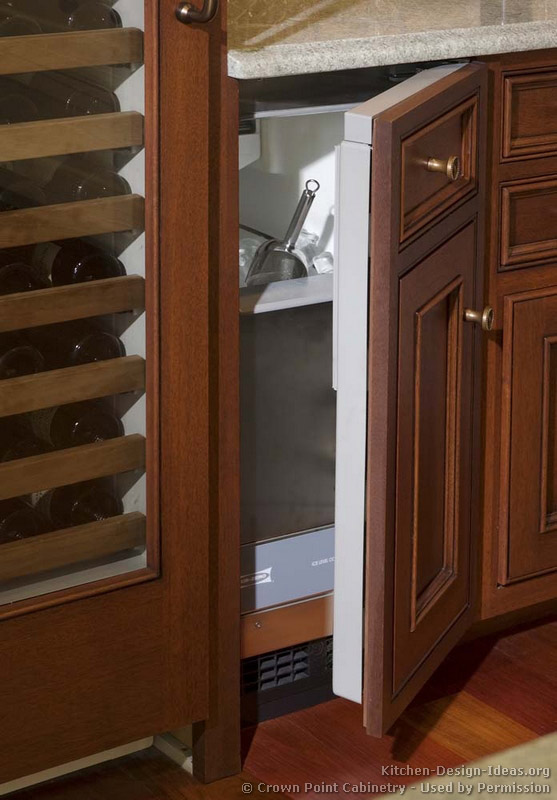
Top Kitchen Appliances for Entertaining: A built-in ice maker is a great help if you entertain frequently.
A built-in ice maker is a great help if you entertain frequently.
1. Ice Maker: It's always a pain to run out of ice in the middle of a party, so why not make your own? A dedicated ice maker does that for you, so you'll never have to step out to grab ice from the store. Unlike your fridge, an ice maker has more than enough capacity to make enough ice to satisfy guests and then some.
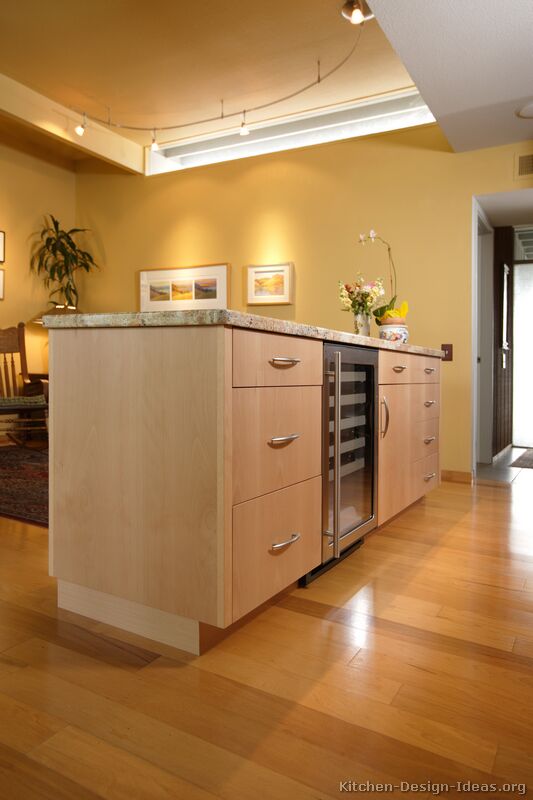
2. Wine Fridge: For those who entertain guests frequently with the finest wines available, a wine fridge is definitely a must-have. In addition to quick access, your wines will stay at a cool pre-set temperature. Dual-zone units are available for keeping a wider variety of wines around.
Top Kitchen Appliances for Entertaining: A wine cooler makes a great addition to a kitchen island, if you have the space for it.
Available in various capacities for unique storage needs, a wine cooler makes a great addition to a kitchen island, if you have the space for it.
3. Food Processor: It takes time to slice, chop, knead and shred those ingredients you need for party appetizers and the like. Why waste time on that when a food processor gets the job done in a fraction of the time? A food processor with a strong motor will last you through countless special events while the variable speeds let you chop, slice and mix almost any food you could think of.
4. Meat Thermometer: Okay, the last thing you want to do is poison your guests! Take all of the guesswork out of cooking chicken, beef or pork with an accurate and highly reliable meat thermometer. The most popular types of meat thermometers include the "ovenproof" thermometer, which remains in the food throughout the cooking process and the instant-read thermometer with a probe that measures internal temperatures quickly.
5. Blender: While food processors deal with chopping, grinding and mixing foods, a blender is the perfect tool for making delicious fruit smoothies, margaritas and even condiments like salad dressings. Don't be afraid to have the two side-by-side during dinner parties.
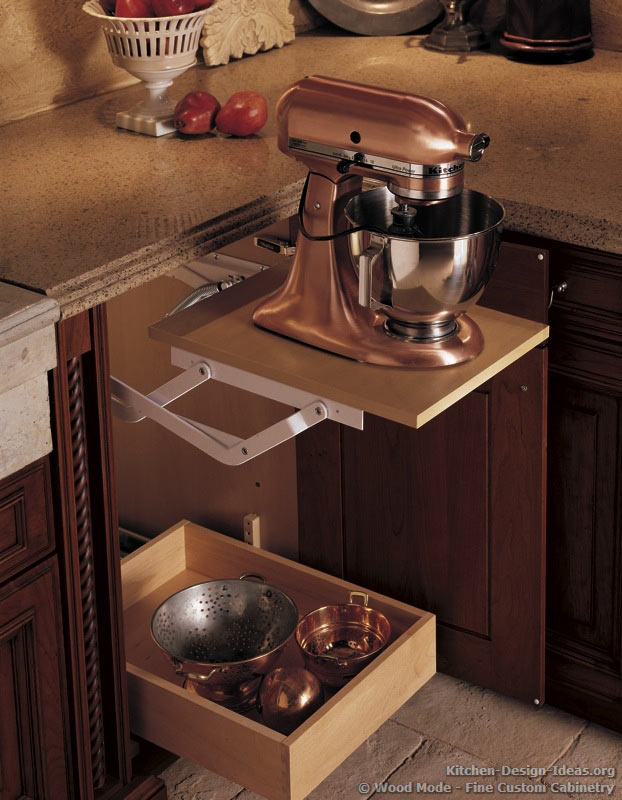
6. Stand Mixers: When you have guests coming over, prep time is in short supply. Having a mixer in the kitchen makes for a great time-saver, plus it saves you from having to wrestle with a whisk or a spoon. You can use a stand mixer to your advantage for whipping potatoes, beating batter and kneading dough or use a portable hand-held mixer to fluff eggs and mix lighter foods. Don't be afraid to have both types around, as each one has its own set of advantages in the kitchen.
Top Kitchen Appliances for Entertaining: Save time and elbow grease with a stand mixer. This one is built onto a mechanized cabinet lift.
Save time and elbow grease with a stand mixer. This one is built onto a mechanized cabinet lift.
7. Crockpot: Having a crockpot on hand is a quick and fun way of cooking those delicious appetizers. From nachos to chili, beans and meatballs, you can whip up a wide variety of appetizing dishes for your guests in little to no time at all. As a bonus, crockpot cooking gives your dishes that delicious slow cooked taste. At our family parties, a triple crock pot server is a huge hit, and a consistent source of compliments.
8. Fondue Pot: A fondue pot is a fancy and fun way to serve up desserts, entrees, and hors d'oeuvres. Make delicious cheese dips for bread sticks, or try decadent chocolate dessert fondues. If you're going all out for a wedding reception or fancy gathering, take desert a step further with a chocolate fountain!
9. Electric Griddles: No report on appliances for entertaining is complete without mention of the wide array of specialty electric griddles, from full-sized grills to specialized quesadilla makers, hot dog machines, pretzel makers, and waffle irons. You can leave these out on a table or countertop for friends & family to informally serve themselves, or use these griddles in advance to more quickly mass-produce your party food.
10. Ice Cream & Popcorn! It's not just the kids who love a good old fashioned ice cream for dessert. You can wow and impress friends, family and guests by making your own homemade ice cream or frozen yogurt with easy-to-use machines. The best thing about having your own ice cream machine is the boundless creativity; you can make any flavor of ice cream you want in as much quantity as your dinner guests desire. For kids' summer parties, a snow cone maker is a fairly popular choice. 
If you're going all out, give your guests the full Disneyland Main Street experience by also adding a cotton candy maker or popcorn maker to the scene. From simple countertop models to old-fashioned carnival style circus carts, nothing makes a party hop like a popcorn machine. While they aren't exactly appropriate for a formal dinner gathering, carnival-style popcorn machines are perfect for kid-friendly summer parties and wedding receptions.

Get the Party Going

It's not always easy to keep friends and family entertained during those special events. Fortunately, these appliances really make the difference when it comes to throwing that perfect brunch or dinner party. These and other catering-style food prep machines are surprisingly easy to find at various department stores and specialty cooking outlets.
What do you think? Can you suggest any more great appliances for entertaining? Let us know in the comments below, or shoot us an email on our contact page. With a little prep, and a great tool set, your home can be host to some fantastic gatherings!


Read more: http://www.kitchen-design-ideas.org/kitchen-appliances-for-entertaining.html#ixzz2dDPvfm00

Thursday, August 22, 2013

Do You Really Need A Home Inspection?

Buying a home can be a very exciting time, but get one thing wrong and it can turn your life upside down.   Performing a home inspection is one of those things that some buyers think they can forego.  However, the home inspection is a vital part of knowing that you are getting a quality home with as few defects as possible versus getting a money pit.

The only way to know if you are getting a good solid, quality home is through the home inspection report.  The home inspection report will help give you an accurate picture of the maintenance required to preserve the home, as well as, what may need to be repaired before you can move in.  Alternatively, it could give you an "out,"  without forfeiting your earnest money, if the inspector uncovers any major flaws in the home.

Always use a licensed home inspector and not your best friends cousin who is a handyman and thinks he is a home building specialist.  A licensed inspector is required to attend classes and pass a test before he is able to become licensed.

Generally, the home inspection only takes a few hours and will cost between  $200-$400 dollars.  The inspector will start by checking the physical  condition of the exterior by looking for cracks in the walls and any signs of water damage, etc.  He will then inspect the electrical, HVAC, plumbing, appliances, water heater and any other features of the home for damage or potential problems.

The home inspector will then report any visible defects; however, they usually don't notate the condition of things like buried pipes, etc.  Although, they will notate if they see any standing water in the yard  that could indicate an underground leak in one of the underground pipes.

The home inspection report will allow the buyer to request that the seller fix the items found on the inspection report before the sale of the home has been completed.   The seller, however, has the option of refusing the repair request and offering the home on an "as is" basis or lowering the price of the home to compensate for those repairs.   If the repairs discovered through the home inspection process are major, it's generally advisable that you walk away and find another more suitable home for you and your family.  Otherwise, you may be looking at bigger problems later on down the road as the problem grows.

If you don't want to start the entire home search over again from scratch, you could opt for a 203K loan or something similar to have those repairs fixed.   Talk to your realtor about what he recommends.  Your realtor may know of another property that would be perfect for you versus going through the time and hassle of any major repairs that are needed on the current home you are interested in.

Tuesday, August 6, 2013

Looking back through 125 years of San Pedro History

Every Tuesday we will post a new blog about the History of San Pedro, California!

1888-1889


  • March 1, 1888- The city of San Pedro was officially incorporated. The first Board of Trustees, sworn in four days later, included president E.W. Webster, J.A. Dufresne, N.O. Anderson, E.M. Phelps and Alex Oleson.
  • The newborn city began to take shape as new groups and societies were organized.. Fifth Street School was established during this decade as well as the citys first library and the volunteer Fire Department.
  • In May of 1888, Augustus Timms donated the land for Harbor View Cemetery (22nd & Grand) on the condition that the center plot be aside for him. He claimed that spot only two months later, upon his death. 
  • In September of 1888, President Grover Cleveland designated the land for a military reserve that would be the future location of Ft. MacArthur.
  • Seaside Pharmacy, arguably San Pedro's longest running business, opened its doors in 1889. It remains in operation today at 599 W. 7th St.
  • Plaza Park is dedicated July 31, 1889. The park pavilion would be added in 1892, many celebrations and musical performances would be conducted from the gazebo in the years ahead. 


More to come on the History of San Pedro next Tuesday!


*San Pedro Today Magazine

Friday, August 2, 2013

Home Prices Still Rising at a Torrid Pace

Key gauge surges 12.2% from a year earlier the largest gain since March 2006.

Home prices shot up in Americas largest cities in May, rising at a pace not seen since the bubble days, according to a closely watched gauge.  The Standard & Poors Case-Shiller index of 20 large U.S. cities released Tuesday, rose 2.4% from April and 12.2% from May 2012- the largest year-over-year gain since March 2006.
Average home prices across the 20 cities have now reached their spring 2004 level. For the first time, two cities- Denver & Dallas  surpassed the peaks they reached before the 2008 financial crisis. All cities tracked by the index saw prices rise from a year earlier and the previous month.

"The long-awaited housing recovery is in full swing," Senior Economist Erik Johnson of IHS Global Insight wrote in an emailed analysis. "We expect housing to remain a key driver of growth for at least the next couple of years."

Low mortgage rates, a shortage of homes for sale and heavy investor demand have sent home prices sharply higher this year, providing an economic lift but also sparking concerns that some markets are overheating.
Las Vegas and Phoenix, two cities where prices fell hard during the bust, have come roaring back, in large part because investors have scooped up many foreclosed properties to flip or rent out. Year-over-year prices rose 23.3% in Las Vegas and 20.6% in Phoenix. Those gains were surpassed only by the San Francisco market, a tech mecca where prices skyrocketed 24.5% from May 2012. Southern California price increases maintained their breakneck pace in May. Prices rose 19.2% in the Los Angeles region over the year and 17.3% in the San Diego area.

"The market is on fire right now," said Max Nelson, a senior partner at Deasy/Penner & Partners Beverly Hills office. Nelson said his company has already received  multiple offers for a Pacific Palisades home it placed on the market Friday for $1.65 million--- before even holding an open house. Those gains are rapidly eating away at affordability, further hampering the efforts of first-time home buyers who often must compete with all cash investor offers in many markets. Stuart Gabriel, director of UCLAs Ziman Center for Real Estate, said the recovery is pricing out some home buyers--- a disconcerting trend.

"The rebound has been striking," he said.

The median home price in the six-county Southland rose 28% in June to $385,000, a record year-over-year gain, according to research firm DataQuick. The median is the point at which half the homes soold for more and half sold for less, so it reflects the mix of homes selling as well as rising values.

- Andrew Khouri

Thursday, August 1, 2013

L.A. Planners to take up Ponte vista proposal

Long-stalled development plans for the former Navy housing property in San Pedro move to the Los Angeles Planning Commission on Tuesday, when the latest vision for the Ponte Vista project will be reviewed.

A hearing on the city's final environmental impact report , released June 27, will be held during the commissions 10 am meeting at the Port of Los Angeles Administration Building at 425 S. Palos Verdes St. in San Pedro.

While the new Ponte Vista plan calls for developing 830 homes- much smaller than earlier proposals that went as high as 2,300 homes- there remains strong opposition among those who want the 61.2-acre property to remain R-1, which would cut the numbers back even further.

Board members of the Northwest San Pedro Neighborhood Council continued to express "serious concerns" about the proposal in its July 8 resolution. Those concerns include a lack of traditional single-family housing and not enough public open space.

Supporters, including the San Pedro Chamber of Commerce, believe the project will work in concept.
Developing the entire parcel at 26900 S. Western Ave. with detached single-family homes would not be financially feasible, according to iStar, which currently owns the property.

Supporters also say its time to move forward on the project after nearly a decade of discussion. As originally planned in 2005, Ponte vista called for building 2,300 homes on a long-vacant and dilapidated site still dotted with old Navy homes.

The proposal encountered wide-spread opposition from residents who said it was too dense and would cause more traffic congestion in the area. The project went through numerous revisions after that as the property also changed hands. It was purchased by iStar Financial in 2010.


Daily Breeze

Thursday, July 4, 2013

Happy 4th of July !

We would like to wish you all a Happy 4th of July!Thank you for reading our blog.


The Inman Team

Wednesday, July 3, 2013

Creating your Mobile Marketing Strategy

Make sure your website displays properly on a smartphone and tablet.  If it does not, adjust your strategy.  Either make your site “responsive” to the device on which it’s being viewed – OR – drive mobile traffic to your profile on another responsive site.  For example,advertisers of The Real Estate Book get a mobile optimized profile and the ability to create a free basic mobile website or an reasonably priced enhanced mobile site.
Use offline tools to drive traffic to your mobile site.  For example, a text or a QR code placed on a yard sign, brochure, a postcard, or an ad will stimulate traffic to your mobile site.  In 2012, advertising pages in The Real Estate Book generated over 300,000 text leads for advertisers. It’s clear that having a call to action placed locally drives response.
SMS text codes placed locally generate more local leads.  Think about your website and those who surf homes online.  You do not know their identity until they decide to register or request more information.  Consumers who have to text a code to see a property are giving you their phone numbers to text them back.   You know who they are right away.
If they text you, respond with a text.   The consumer has chosen their preferred method of communication.  Respect it.  If, after a few texts back and forth, things would be easier explained with a phone call, then call them.  It’s not that you should not call them.  You should just not call them first.  It can be seen as intrusive or pushy.  Instead, text and say, “Did you find the information you needed?  Would you like to know more?”
Mobile leads are leads, not sales.  Recently a local representative told me that not every text lead was converting to business for him.  Let’s set the expectation correctly.  It’s a lead, not a guaranteed sale – or even a conversation.  You still have to work to convert the lead into a conversation, a meeting, some showings, and, hopefully, a sale.  Not every lead you receive from any source always results in a sale.   Also consider that the prospect may be working with another agent and may have that agent set up the showing with you once they've determined their interest.  It may end up being a sale, but you might not be aware of the source of the interest.
Use your mobile marketing strategy in YOUR LISTING PRESENTATION.  In survey after survey, home sellers say that the most important service their agent can offer them is marketing their home to potential buyers.  Make sure they know that you are ahead of the curve when it comes to current marketing trends.  It will increase your credibility, your competitive edge, and your listings. When we put together our presentations for our potential clients, we always include about 3 or 4 pages with how we will market there home. The pages usually include the
 social media websites we use and what advertisements there home will be in. Be sure to specifically write the web address so your clients cant go check out your Facebook page, twitter, Tumblr, Pinterest, Instagram, etc. And for the advertisements put in examples, like if you put homes in the Daily Breeze or DIGS magazine, be sure to bring them a copy of the latest issue with your Ad in it. 

Tuesday, July 2, 2013

Help Discouraged Buyers Stay on Track

Inventory continues to shrink in dozens of metro markets all around the country, creating a headache for buyers who are ready to jump into the market but can’t find the right place. In some cases, these buyers are turning to new construction as an alternative.

How do you keep buyers in the game when demand is outpacing supply? Here are some key steps:

Encourage Them to Get Pre-approved
For starters, get your buyers pre-approved before looking at houses. This is crucial, perhaps more than ever, because of the tight time frames homes are selling in. Encourage buyers to gather documentation they’ll need to submit for a pre-approval, and connect them with a trusted lender in your area to move the process in the right direction. And then—only after this key step is completed—start looking at properties.

Don’t Waste Any Time
If you or your buyers find a home that fits their needs today, you’ll want to get them in for a showing within 24 to 48 hours. Waiting until the weekend to look at a home they really like is not a good idea; the home could be sold by then. Similarly, if your clients see a home they love and want to write an offer, be ready to do so on the spot.

Write Strong Offers
Some buyers think they can still get away with making lowball offers and asking for the washer, dryer and a carpet allowance. With the return of bidding wars and multiple offers, buyers must be ready to present their highest and best offer, and they should ask for minimal concessions. If your buyers can afford to put down more earnest money and a larger down payment, they increase their odds of beating out the competition.

Keep Expectations Realistic
If your buyers are bound to a restrictive price range, don’t let them fall into the trap of reaching beyond their means, no matter how much they’d like to get into a home. Keep their expectations realistic, and advise them to walk away if the transaction simply doesn't work for them. They’ll thank you for it.

Save the Listing Agent’s Time
Listing agents are busy and under the gun to get homes sold. Be the best agent they’ve ever worked with by submitting an offer package complete with a pre-approval letter, a strong, well-written offer and any other supporting documentation that could help your buyers make an impression. Be concise, thorough and responsive, and your efforts could put your clients at the front of the pack if all other things are equal. When it comes down to it, your buyers may still have a tough time finding their dream home in a low-inventory market. New construction is a great alternative; cultivate relationships with local builders and preview some of the up-and-coming projects to familiarize yourself with what’s there. Builders will pay you a commission for bringing a buyer, making this equally beneficial for you and your clients.

Whether it’s a traditional resale or a new home, your knowledge, market expertise and
proactive approach can deliver exactly what your clients are looking for—even in a seller’s market. Above all, stay positive and encourage your buyers not to give up.

Monday, July 1, 2013

9 Ways to Make your Offer Irresistible to Sellers

1. Pay cash. Investors have been snapping up homes to flip or rent, and they usually come to the table with cash. Sellers love all-cash offers because they’re less likely to fall through before the sale closes. In January, all-cash transactions accounted for 28% of existing home sales, according to the National Association of Realtors. Cities currently attracting strong investor interest include Atlanta, Detroit, Las Vegas and Phoenix, reports CoreLogic. If you need a mortgage, a low appraisal could cause your bank to back out of the deal, forcing the sellers to put the house back on the market.
2. Get preapproved. If you can’t pay cash, you’ll need to get a mortgage. Three or four months before you shop for a home, check your credit reports, says Michael Corbett, a consultant to real estate Web site Trulia and author of Before You Buy! That will give you time to dispute any errors and take short-term steps, such as paying off debts, that will improve your credit score. You can get your reports once a year free from the three major credit bureaus at www.annualcreditreport.com. Then get a bank’s pre-approval. It won’t guarantee that you’ll get a loan, but it will show sellers that a lender has verified your income and credit score and determined that you can afford payments on a mortgage for a certain amount.

3. Make your best offer on price. You may only have one shot to get it right, so make your best offer—what you’re willing and able to pay. Base your offer on recent sale prices of com­parable properties in the neighborhood so that it will pass muster when the property is appraised. If you hold back, thinking you’ll sweeten the offer on the second try, you may lose the property to another buyer.
4. Up the ante. You can add an escalator clause, with which you agree to ratchet up your offer if there’s a higher bid from another buyer. Keep in mind that if you agree to pay more than the market value determined by an appraisal, you’re on the hook for the difference from your own funds.
5. Beef up your earnest money. This deposit signals how serious a buyer you are. Try doubling the amount that the seller requests or that is customary in the area. If you must renege on the offer for any reason allowed by the contract or state law, you’ll get your money back.
6. Pay for extras yourself. These might include some of the closing costs, homeowners association dues that must be prepaid, a one-time contribution to a community-enhancement fund, or a home warranty.
7. Make contingencies palatable. Most sellers prefer offers with no contingencies, but you probably can’t afford to forgo the protection that contingencies provide if you want to cancel the contract. Offset a financing contingency with preapproval and a strong earnest money deposit. If you have enough cash, temper an appraisal contingency by assuring sellers that if the appraisal comes in lower than the purchase price, you’ll pay the difference or split it with them (up to a certain amount). Include a home-inspection contingency, but tell sellers that you will cover the cost of any repairs. If the price tag on those repairs gets out of hand, you can back out of the deal.
8. Write a love letter to the sellers. Re/Max agent Gayle Henderson, of Scottsdale, Ariz., says this will help you connect with the sellers, especially if you haven’t met them. She suggests such points as: "We’re relocating from..." "We see ourselves living in your neighborhood or chose your schools because..." "We especially love..." and "We appreciate your accommodating our visits."
9. Give the gift of time. Express your willingness to work with the sellers’ timetable to go to closing. If the sellers want to remain in the home for a while after closing, offer them a "lease back" or "rent back," which means that you will be their temporary landlord. This is a legal arrangement, and you’ll need to work out the details with your agents and be sure that the sellers keep their homeowners insurance during their stay. If you are bidding on a short sale, make clear to the sellers that you are patient and can wait for the bank’s decision.
Read more at http://www.kiplinger.com/article/real-estate/T010-C000-S002-make-your-home-offer-irresistible-to-sellers.html#5qjijkg2xcTt5RHe.99 

Wednesday, June 26, 2013

5 Signs you're Ready for Home Ownership

1.You Stick to a Budget
Financial experts will tell you that creating and sticking to a budget is a sign of financial maturity. With the over 1.5 million foreclosures in the United States, it's easy to understand why this is so important. If you have already created a budget and have stuck to it, you're more ready than the next guy to own your own home. When you follow a budget, you know exactly where your money is going each month. When you know where your money is going, you know whether or not you can afford a home of your own.

2.You Have a Down Payment
The old rule of thumb still stands: Enough money should be saved for a 20 percent down payment on a house. When you put 20 percent down on a home, you immediately have equity built into the property and you negate the necessity of private mortgage insurance. Even with a 20 percent down payment, you should still stay away from home's that are out of your realistic price range. If you've budgeted for a $150,000 house, having 20 percent to put down doesn't mean that you should look for an $180,000 home.

3.Your Income is Stable
Finding a stable job can be tough to do in today's economy, but if you have a stable source of income, you can feel relatively safe making an investment in a home. If you are reliably employed, don't forget to factor in any life-changes that may crop up in the near or distant future. Do you plan to go back to school? Are you going to start a family? Budget for the home you can afford five years from now, not the one you can afford today.

4.Your Credit Score is High
The higher your credit score, the better your interest rate will be. The better your credit score, the more likely you are to be accepted for a loan. If your credit is in excellent shape, you're ready to buy a home. If, on the other hand, your credit needs some work, whip it into shape before you being the home-buying process. Before you buy a house, your debts should be paid off, any collections accounts should be closed satisfactorily, and your credit score should be in the 700's.

5.You Have an Emergency Account
Did you know that you should have enough money in the bank to cover at least three month worth of debt? If you have an emergency account, you can feel safe buying a home. Add your estimated mortgage payment, estimated utilities, and any recurring debts that you have, and multiply that number by three. The resultant number is the amount that you should have stashed away in the case of job loss, illness or other financial emergency.
If you are thinking of buying a home, make sure that you are 100 percent ready. Re-read the tips above and, if they apply to you, the dream of owning your own home is within reach. If one or more doesn't apply to you, you have some work to do. Owning a home isn't a snap decision, it's a process. In the end, you'll be glad that you took your time and did it right.